After an amazing Climate Jam 2025, we’re looking forward to being in community and creating together in 2026. The world is changing fast. What kinds of games should we be making this year? Let us know if you have ideas for themes for Climate Jam 2026. Contact us at earthgamesuw@gmail.com.
Climate Jam 2025 starts Friday!!
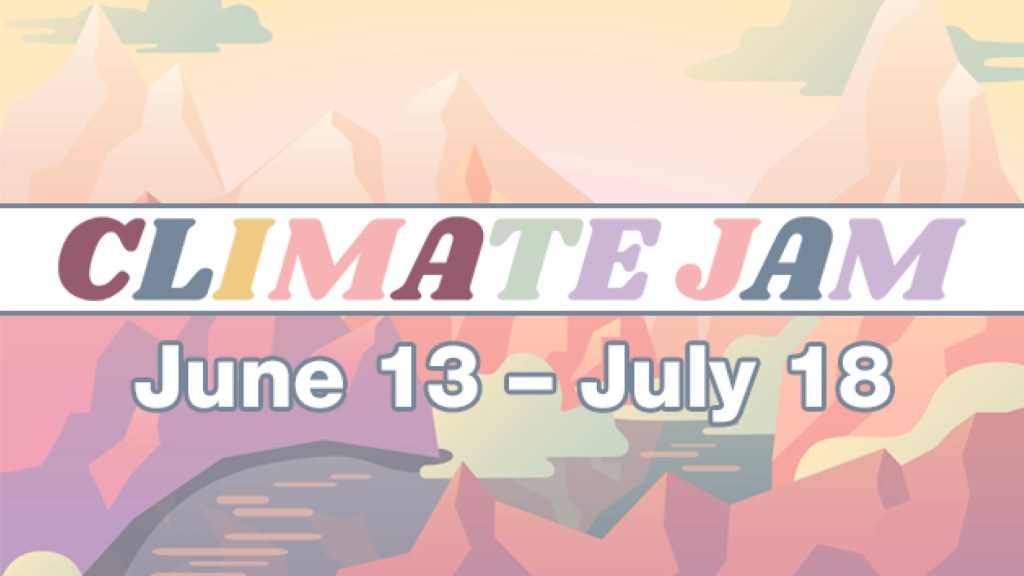
The 2025 edition of the Climate Game Jam starts on Friday! We’ll kickoff at 6 PM Pacific with a keynote presentation from Isabel Carrera Zamanillo (Front and Centered).
The jam goes from June 13-July 18, and all skill levels are welcome! Last year we had 500 participants and nearly 50 games were created!
https://www.indiecade.com/climate-jam/
Fun and Games at Polar Science Weekend!
EarthGames would most definitely consider Polar Science Day to be a success!! Lots of the kids really loved the games, and lots of parents loved that their kids were learning at the same time. We got to teach over 100 different kids about albedo (Soot Out at the 0oC Corral) and permafrost (Erode Runner) and it was beyond a fulfilling experience. We set up QR codes for families to play the Soot Out game on their own devices, but it quickly became the way we directed parents to find the rest of the games.
We had a ton of fun, decided the Pacific Science Center may be the greatest thing ever, and have an intense sense of fulfillment after seeing so many kids learn important topics. Teaching may be the most important thing in life!
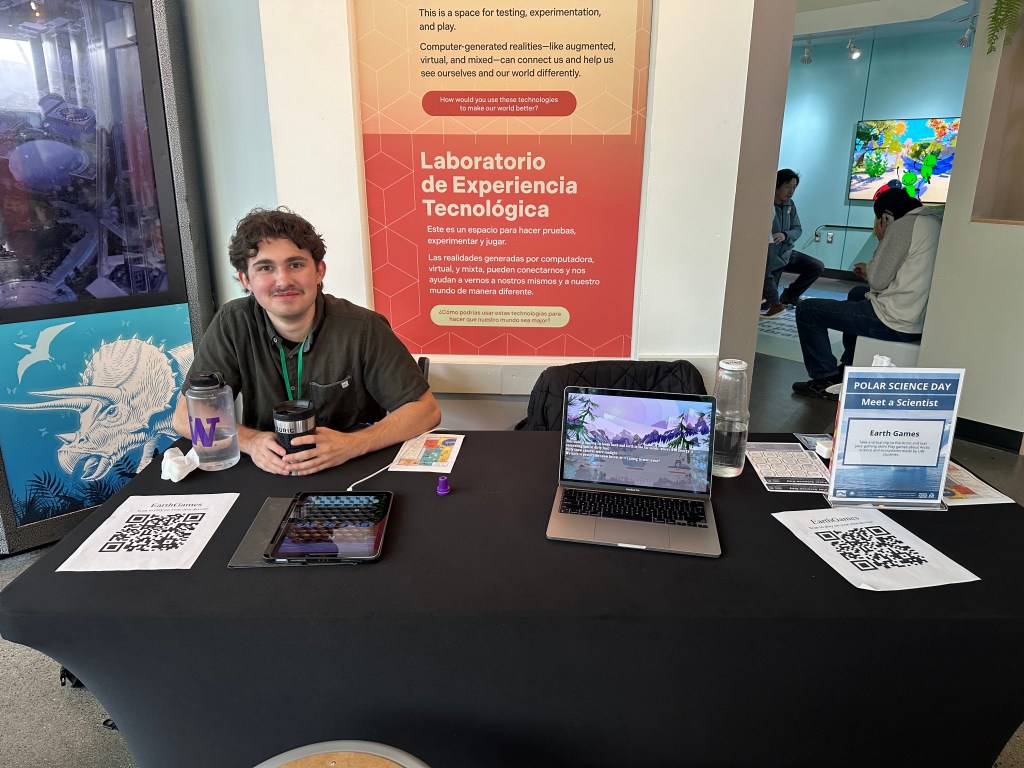

EarthGames at Pacific Science Center!
We’ll be back at Pacific Science Center for Polar Science Day! It’s April 12, 10 AM to 5 PM, and we’ll be showing our Arctic Trilogy Games. Hope to see you there!
Also stay tuned for info about this year’s Climate Jam on Earth Day!
New Game: Sustainability Action Arena: Video Games for Sustainability Targets at UW
Introducing the Sustainability Action Arena, a zany and fun tour of the University of Washington’s Sustainability Action Plan!!! Compete in mini-games that outline the ten steps that UW is enacting to increase equitable and local purchasing, student engagement, and research regarding sustainability while trying to beat your high score!
Through a partnership between Earth Games Studio and UW Sustainability, we have been working for a long time to put together a fun and interesting way to navigate UW’s steps on how they are making a green future, a real reality.
Thank you to the UDUB Minecraft Team for providing the screenshots from their one-to-one replica of campus to provide as the background images for our game and the Campus Sustainability Fund for funding the project.
Click Here To Read More About UW’s Sustainability Action Plan

Climate Jam 2024 & EarthGames In the News!
Our annual Climate Game Jam, co-organized with IndieCade, kicked off one month ago… and it’s only now coming to an end! Instead of the weekend jams we used to host at Pacific Science Center or at UW, or our recent annual week-long virtual jams, this year we’re using the Greenlight Jam format. There are different week-long sprints, including ideation, prototyping, production, and marketing.
It’s turning out to be a huge success! Over 400 jammers have registered, and 67 prototypes were submitted during the second week sprint (59 are playable here). The amount of talent and creativity displayed among the jammers is just incredible! We can’t wait to see the final submissions soon.
In other news, a climate change version of the classic board game Catan was recently released, called Catan: New Energies. Grist recently interviewed Dargan for their article about the game, who said “It’s just more evidence that people have climate change at the top of their minds now… There’s demand for ways to think about it, deal with it, in fun ways.”
Highlights from the Climate Game Jam 2022
There were so many amazing games made in the IndieCade/Games for Our Future/UW EarthLab Climate Game Jam 2022! In honor of the Science Friday segment about the jam airing today, we made a twitter thread about 12 of our favorites, in such a wide range of genres. Hope you have as much fun with these games as we have!
https://platform.twitter.com/widgets.jsIn honor of the @scifri segment on the Climate Game Jam airing today, here's a thread of some of our favorite games from the event!
— EarthGames (@EarthGamesUW) August 12, 2022
The winner was Row, an epic narrative RPG about coexisting after a flood. Can't wait for the new version coming this fall! https://t.co/F3Inru8ZHO pic.twitter.com/vntEHpBJaT
New Version of Future Climate!
Check it out for free on itch.io! It should work in your browser and on mobile.
https://earthgamesuw.itch.io/future-climate
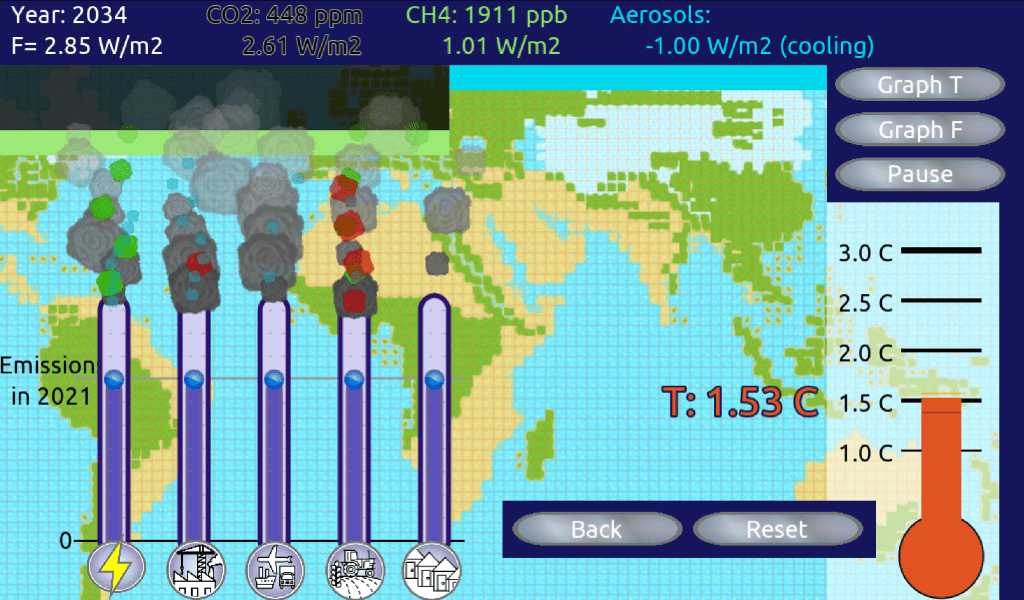
Future Climate is a science-based climate model that allows you to simulate future global warming. It starts with the world today, and calculates global-averaged temperature based on your choices.
There are three modes:
- Simple mode allows you to change all pollutants (carbon dioxide, methane and aerosols) at once.
- Sector mode lets you change each economic sector separately: electricity, transportation, industry, agriculture and buildings.
- Gas mode allows you to change carbon dioxide, methane, nitrous oxide and aerosols individually.
If you’re decreasing all emissions at once, temperatures will initially spike, due to the removal of aerosols, which block out the sun. Over the next few decades, methane decreases, and temperatures go back to where they were before you changed emissions. Carbon dioxide lasts an extremely long time in the atmosphere, so temperatures stabilize at around that same value.
The app simulates three different possible future in each mode: one with a high climate sensitivity and large negative aerosol forcing (the dark red line), the middle range (red, number displayed as well), and a low climate sensitivity and low aerosol forcing case (yellow).
This model is a simplified version of the FaIR v1.3 climate model.
Climate Game Jam 2022 starts on Earth Day!
We are once again inviting game creators from around the world to make games that explore solutions to address a rapidly changing planet. Together we can make a difference!
This year’s Climate Game Jam will be virtual, from April 22-May 1. The theme is Empathy and Equilibrium and we’re looking for games that explore this theme through the lens of
- Media, Storytelling and Misinformation
- Nature and Health
- Green Energy
- Food and Food Systems
- Climate Optimism
We’re co-sponsoring with IndieCade, Games for the Future, Seattle Indies and EarthLab. Check out more info on the website: https://www.indiecade.com/climate-jam/ or sign up at itch.io: https://itch.io/jam/climate-jam-2022.

Join us on Discord! – IGDA Climate SIG Discord – Our friends at the IGDA Climate Special Interest Group (SIG) are here to help us with our creations and have a lot of resources available for you to use during the jam and beyond. It is also an easy way to ask questions, chat and meet other jammers.
Interested in becoming a mentor? Sign up here!
Sustainability Action Arena: Video Games for Sustainability Targets at UW
EarthGames has a new game in the works! This game will center around the UW Sustainability Action Plan to spread awareness and educate students, faculty, and anyone else interested on steps the UW community is taking to make our community more sustainable.
This interactive game features familiar arcade-style minigames, original music, a realistic navigation map, thanks to our friends at UDub Minecraft, and much more.

Keep an eye out for monthly updates! Play the game here (password is: Test2)!
 EarthGames